Player Information:
Name: i
Age: 29ish (shhhhhh)
Contact: redgungirl (AIM)
Character Information:
Name: Katara
Canon: Avatar: The Last Airbender
Reference: one | two
Setting:
The world of Avatar: The Last Airbender is fantastic, expansive, and diverse, deftly combining both the familiar and unfamiliar to build its own rich mythology, history, culture, geography and more. It is almost impossible to describe it in a few paragraphs, but likely it's best to start where all things do: at the beginning.
Creation + Convergence
Once, long ago, before the time of humans, there were spirits. The oldest known spirit was known as Raava, the spirit of peace and light. Since the beginning of time, she and her counterpart Vaatu, the spirit of darkness and chaos, engaged in a never-ending battle, neither fully able to defeat the other. Every ten thousand years, a phenomenon known as the Harmonic Convergence occurred, when the planets aligned and spiritual energy was greatly amplified. During this, Raava and Vaatu would engage in a battle that determined the fate of the world until the next Harmonic Convergence.
At this point, nearly 20,000 years before the start of the series, humans and spirits lived on different planes of existence; the humans on a physical plane, and the spirits in a separate realm. Prior to the Harmonic Convergence, Vaatu was somehow able to destroy the barrier between the planes, and allowed the two to merge. Now with access to both spirits and humans, Vaatu had the opportunity to wield tremendous destructive power. However, the aforementioned Harmonic Convergence commenced, and Raava remained the victor, able to suppress Vaatu for the next 10,000 years.
Because Vaatu destroyed the barrier between the planes, humans now lived on the same plane with spirits. Spirits were wild and dangerous, and the humans required protection. Lion turtles, unfathomably huge and with the ability to bestow the humans with power to protect themselves, were able to afford them this protection and allowed humans to build cities atop their shells. When humans needed to venture into the Spirit Wilds, the lion turtles were able to bestow upon them the ability to manipulate one of four elements: water, earth, fire, or air. These humans would become the first element benders.
Because the lion turtles were solitary creatures and were large distances apart, most humans were unaware that cities and elements other than their own existed. (This is important to note, as it would become the backbone for the current Avatar geography, each separate nation spread across the world with their own geography, landmarks, climates, and demography: the Air Nomads, the Water Tribe, the Earth Kingdom, and the Fire Nation. But more on that later.) Armed with their temporary bending and looked after by the lion turtles, humans were able to co-exist with spirits --
The First Avatar
-- until a smartass thief named Wan was banished from his home and decided he had enough of being poor and hungry. Wan was a noble and brave, but reckless and impulsive man who sought the power to better himself and the people around him. After being bestowed firebending by a fire lion turtle, he took a journey to the Spirit Wilds to refine his skills. There he befriended the spirits who recommended that he journey to other lion turtle cities and attempt to learn to control the other three elements. On the way, he came across Raava and Vaatu engaged in battle. Vaatu was able to appeal to him, claiming that he had been tortured at the hands of Raava for nearly ten thousand years, and Wan used his firebending to sever the link between the two.
Understandably, Raava was upset about this turn of events, and explained to Wan what he had really done. Wan, remorseful, offered to help Raava defeat Vaatu. They traveled to the other lion turtle cities together, requesting of each the power of the elements, and they worked together for Wan to master them. Eventually, he did, but proved no match for Vaatu during their final battle. As a last resort, Wan permanently bonded his spirit with Raava's, creating the Avatar Spirit and the first Avatar. With his new-found strength, Wan managed to trap Vaatu in an elemental cage and imprison him in the Spirit World. He then closed all the Spirit World portals, permanently preventing any human from ever physically entering the Spirit World and releasing him. He announced that, as the Avatar, the only man with the ability to control all four elements, he would be the bridge between the two worlds and keep balance.
Although Wan attempted to do such that throughout his entire lifetime, humans were kind of assholes, and it was very difficult task. Mankind began to leave the lion turtle cities, choosing to keep their bending skills permanently in order to defend themselves and venturing out on their own. The lion turtles released the humans from their protective custody and soon, one by one, became extinct. Wars ravaged the lands, and Wan believed he had failed. Dying, he apologized to Raava for failing her. The light spirit reassured him that they would always be together and they would never give up. With that, Wan exhaled his last breath and his spirit left his body to be reincarnated -- into the next person who would become the Avatar.
The Four Nations
Humanity began to divide themselves geographically and developed into nations based on their elemental affinity. The fighting styles associated with each element were derived by the creators of the series from different styles of Chinese martial arts, with each fighting style chosen to represent the element it projected.

The Air Nomads made their way to every corner of the earth, establishing one air temple in each of the four compass directions. The theocratic people were home to a monastic order of men and women, and, due to their innate spirituality, all Air Nomads were, without exception, benders. They were the smallest nation in the world, with a small but self sustaining economy. Ba Gua, which uses dynamic circular movements and quick directional changes, is used as the basis for airbending.

After long period of civil unrest, the Water Tribe split into two groups: the larger faction stayed at the North Pole while the other group settled the South. These would become the Northern Water Tribe and the Southern Water Tribe respectively. The Water Tribes are a peaceful people, and their abilities are naturally tailored toward defense. Along this vein, they have developed a sub-skill of waterbending that involves healing wounds by redirecting energy paths throughout the body using water as a catalyst. T'ai chi is used as the basis for waterbending in the series, which focuses on alignment, body structure, breath, and visualization.

Earthbenders left their earth lion turtles and settle over a large area of land. Over time, the Earth Kingdom was united under the political authority of the city-state of Ba Sing Se. The King of Ba Sing Se became the Earth King, overlord of all of the smaller kingdoms within the Earth Kingdom, some of which retained their own hereditary lordship. Earthbenders are generally muscular, tough and direct, much like the earth itself. Hung Gar is used for earthbending in the series, and was chosen for its firmly rooted stances and powerful strikes to present the solid nature of earth.

The ancestors of the first Fire Nation citizens left the lion turtle cities in favor of establishing settlements in the western hemisphere along the equator. They settled on an archipelago of tropical volcanic islands, many still active, that give the nation an unlimited source of power. Their firebending, which uses strong arm and leg movements, is based on the powerful Northern Shaolin style of martial arts. Power becomes a common theme among the Fire Nation; they retain their longstanding desire to conquer and expand to the current day. This brings us to how --
Everything Changed When the Fire Nation Attacked
Approximately 150 years prior to the start of the series, the next Avatar was born: Roku of the Fire Nation. Future Fire Lord Sozin, who would be his childhood best friend, was born on the same day. After Sozin took the throne, he and Roku butted heads many times over Sozin's aggressive political policies and relentless imperialism. In the eventual confrontation, Roku easily overpowered Sozin, but spared him his life for the sake of their past friendship. Many years later, during a volcanic explosion near his home, Roku was left to die by his old friend, knowing that, without the Avatar to interfere, Sozin could finally begin to take control of the world.
As it was common knowledge that the next Avatar would be of the Air Nomad variety (as the Avatar cycle follows both the seasons and the order in which Wan learned the elements), Sozin lead a large scale attack using the fire-enhancing power of a comet and eradicated the Air Nomads in an attempt to preemptively eliminate the next Avatar. The genocide of the peaceful people kicked off the Hundred Year War. Taking advantage of the absence of the Avatar and using their military, economical, and technological superiority to advance their station, the Fire Nation was able to wreak worldwide destruction and widespread loss of life in the other nations.
However, Sozin soon came to realize that he had not, in fact, killed the Avatar. He would spend the rest of his life searching for the missing Air Nomad, but he would never find him.
And the war raged on.
Aang + the Gaang
The adventure in Avatar: The Last Airbender actually starts when Katara, the only waterbender left in the Southern Water Tribe, figured out what happened to the Avatar. Shortly before the beginning of the Hundred Year War, Aang was frozen in an iceberg for a hundred years. After an argument with her brother, Katara accidentally bent the iceberg open and an airbender tumbled out. Aang, still biologically twelve years old, was brought into a world engulfed by war, and would have to learn to control all four elements in order to end the conflict and bring peace to the four nations.
Personality:
Katara was born in the Southern Water Tribe, the youngest child to the chief, Hakoda, and his wife, Kya. By this time in Avatar history, nearly a hundred years into the war, the Fire Nation had nearly decimated the Southern Water Tribe entirely, capturing and killing all of the known benders. When Katara was small, a Fire Nation special forces unit called the Southern Raiders invaded her home. During the attack, their leader, Yon Rha, demanded that Katara's mother bring him the last waterbender. Kya, protecting her daughter, claimed that she herself was the last bender, and Yon Rha, not planning to take any prisoners, killed her.
Kya's murder had a profound impact on Katara from an early age. Firstly, it prompted her father and the other Southern warriors to leave the South Pole and join the Earth Kingdom's forces against the Fire Nation in the war. Although her grandmother, Kanna, and her older brother, Sokka, remained behind to help raise her, she began to take more and more of the familial responsibilities on herself. This becomes the basis for the role Katara eventually takes within the Gaang -- she is the self-appointed authoritarian-figure. In one of the most touching scenes in the series, Katara overhears her brother tell Toph that because Katara has been taking care of him so long, over time, whenever he thinks about his mother, he can only see Katara's face. This is both good and bad: because she is so used to taking care of everyone else, she's at first unaware when she becomes overly domineering, bossy and inflexible. These attributes, combined with her strong sense of morality and short temper, meant that she could also be self-righteous and preachy.
These more negative facets of her personality become a sticking point for Toph, the blind earthbender of the group, who, by nature, is fiercely independent. Although they are close friends, Toph is often annoyed at Katara's overbearing tendencies. [ Examples from The Chase. ] This comes to a head in the Runaway, when Katara believes that Toph is doing something dangerous and immoral (cheating Fire Nation civilians out of their money using earthbending) and Toph thinks that Katara should mind her own fussy britches. Eventually, after getting caught by the authorities, they make up -- Toph acknowledging that Katara is the way she is because she cares, and Katara agreeing that maybe she could stand to become a little more flexible and open to fun.
Secondly, after Katara and Sokka find Aang in the iceberg, Katara is quickly amenable to helping him learn to master all four elements in order to defeat the Fire Nation and bring the end of the war. While Sokka (as usual) is a little more cynical, Katara is easily able to put her faith in Aang as the missing link, the key to saving the world. Actually, as one of the most compassionate, empathetic characters in this series, Katara has fierce loyalty to her friends, family and especially Aang. No matter what obstacles they face, what barriers they must traverse, Katara is steadfast in her belief that Aang will save the world. This is lampooned in the episode Ember Island Players, in which Katara is portrayed as absurdly emotional and melodramatic, prone to randomly bursting into tears and deliver speeches about hope. Though exaggerated, there is a grain of truth in this portrayal: Katara is not only unafraid to show emotion, but her belief in herself and her companions more often than not becomes the glue that holds the group together.
Lastly, Katara's hatred and resentment of the Fire Nation (and how to move past it) becomes a major theme in both her own personal growth and her relationships with the people around her. In fact, one could theorize that the path to forgiveness could be Katara's entire character arc. Although she is empathetic, caring, and quick to assume the best of people, she has the most to lose when her trust is betrayed. This is most evident in her relationship with Zuko, and how she eventually comes to forgive him. At the beginning of the series, Zuko is the primary antagonist, the banished Prince of the Fire Nation looking to reclaim his honor by finding the Avatar, and, by extension, acceptance from his father. He and Katara clash many times, both physically and ideologically, as Katara would protect Aang at any cost.
It is important to note that although Katara and Zuko appear to be polar opposites in terms of personality (as one would expect with opposite elemental affinity), they do have many themes in common. In particular, they both struggle with aspects of forgiveness -- Katara, with the struggle to forgive those who have hurt her, and Zuko, with the struggle to forgive himself. This comes heavily into play in the season two climax, when they find themselves trapped together in the Crystal Catacombs underneath the Earth Kingdom city of Ba Sing Se. They talk about what the Fire Nation had stolen from them -- their mothers -- and he apologizes to her. At this point it seems as if Katara begins to trust him. She goes from defensive and mistrustful to open and honest, and she offers to heal his scar.
Had this conversation taken place at the end of Zuko's character arc, the Katara vs. Zuko conflict that comes heavily into play during the last season would never have happened. However, Zuko was still coming to terms with his own loyalties, and he repays her kindness by executing his cruelest face-heel-turn by attacking her and Aang with his sister. Eventually, Zuko does come around (his character growth could be an entire thesis on its own), but by this time Katara has taken his betrayal personally and is unwilling to forgive his transgressions even as every single person around her (even Sokka!) accepted him.
Zuko notes that Katara often mentions the loss of her mother when being particularly resentful of him, and he theorizes that she is displacing much of the anger she feels toward the Fire Nation itself onto Zuko. In order to help her deal with that anger (and prove to her that he really is on her side), Zuko offers to help her find the man who killed Kya. They find Yon Rha retired in a small village, living a miserable life with his even more miserable mother. Katara is formidable and fierce, and unleashes a storm of icicles in his direction. When faced with the opportunity to kill him, however, she finds herself unable to pull the proverbial trigger. Facing the weak and pitiful man was enough to bring closure. She wouldn't forgive him -- she would never forgive him, but she could come to terms with her anger and let it go.
Only then, as if the burden of resentment she'd been carrying around had lifted a fog around her, is she seeing clearly enough to truly forgive Zuko and reaffirm her trust in him. And once she does that, the overly domineering, self-righteous and downright bossy facets of her personality begin to soften. She goes into the final battle of the series a mature, serious fighter with a desire to help win the war and bring peace to the nations.
A wonderfully complex character, it's difficult to pin down Katara's personality in a few paragraphs. She's a healer, a caretaker, and a mediator, a fighter, and a believer. She's also a teenager with all the requisite angst, a girl with a crush, and a daughter with abandonment issues. She's more than just the sum of her parts, and someone with infinite potential for growth and development.
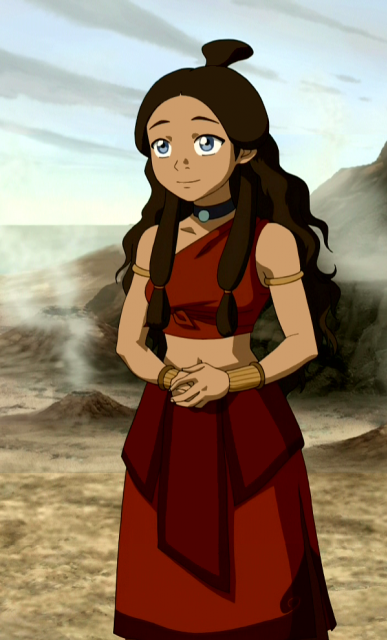
Appearance: one | two
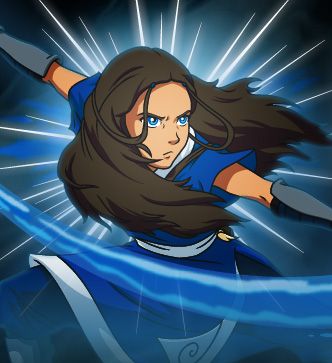
Abilities: Katara's biggest strength by far is her waterbending, which, by the time she shows up in-game, has reached mastery level and beyond. She can manipulate water -- any water, from moisture in the air to sweat to the dew on plants to water she carries in a canteen to large oceans – to cut, wave, whip and defend. She has the ability to control the temperature of water at will, melting existing ice, forming it into various shapes (including ice spikes, which are a deadly weapon), freezing water, create giant walls of mist and steam for defense, transform steam into ice, and evaporate large amounts of water. She can also stand, walk and run on the surface of large bodies of water.
Katara is also capable of bloodbending, a technique that allows a waterbender to control the water in the blood of an opponent. Using this technique, she can bend her opponent to her will, controlling their bodies remotely. Though she is a master of this technique, she is reluctant to use it (with one exception: she used it without remorse on the man she thought had killed her mother).
Late in the first season, Katara discovered that she could use water to heal. She has been shown to use her waterbending to relieve sickness, temporarily alleviate brainwashing, and heal some mortal wounds. She cannot, however, cure all sickness, all brainwashing, or heal severe internal injuries.
Like all waterbenders, her bending is most powerful during the full moon.
This is a nice montage of clips of Katara bending.
Leave a comment